
6 Popular Animatronics or Lifelike Primitive Human Model Options

Since we are a company specializing in making ancient eras themed models / attractions, in addition to popular animatronic dinosaurs and animatronic Ice Age animals, we also customize life-sized primitive human models. Our clients use these decorative primitive human models to embellish scenes of ancient hunting or to showcase the lifestyle of prehistoric humans, which is also an extremely appealing attraction for modern people.
Here we will showcase the six best-selling types of ancient human models. If you are also interested in realistic primitive human models, you can purchase six types as below, which also fit well with the theme of prehistoric animals.
Animatronics primitive human model video:
QUICK FACTS:
#1. Australopithecine / Australopithecus Model
#2. Homo Habilis Model
#3. Homo Erectus Model
#4. Neanderthal Man Model
#5. Denisovans Model
#6. Homo Sapiens Model
1. Australopithecine / Australopithecus Model
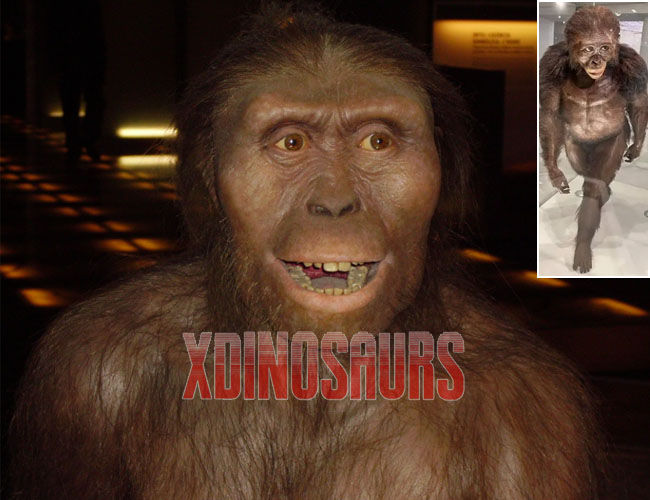
This is one of the known human origin species. Their era of life on Earth was extremely ancient, and their entire body hair was still in the primitive ape-like state. We often make human models of Australopithecus with a height of 1.3 to 1.7 meters. And we also have to customize weapons such as wooden sticks, stone axes, and stone spears for them to make them look truly in a hunting and defensive state. Placing 10 to 20 lifelike Australopithecus models in locations like “Prehistoric Park” or “Ice Age Park on Earth” will definitely create an atmosphere of exploring and discovering the prehistoric Earth.
More knowledge:
Australopithecus, a genus of the family Hominidae in the order Primates, was about 1.5 meters in length and weighed around 65 kilograms. It had a brain about one-third the size of a modern human’s, long hair on its skin, and was capable of walking upright. It had large teeth, a wide lower jaw, a broad and long face, and very prominent zygomatic arches with thick masticatory muscles. Australopithecus lived in Africa approximately 4.5 to 2.5 million years ago. It moved in forests and often walked to open grasslands to forage, so it mostly chose habitats that were close to both forests and grasslands. Australopithecus preferred to live in groups, with one male and several females in a group, with the male as the leader.
Animatronics Australopithecine model video:
2. Homo Habilis Model

Homo habilis is generally considered a descendant of Australopithecus, but more advanced than Australopithecus. Homo habilis had a flatter face, a higher forehead, and a larger brain capacity (approximately 700 ml), and was also more intelligent than Australopithecus. Because their tools, weapons, and containers were more advanced, we often craft these items with greater detail. Furthermore, our custom-made Homo habilis figures are 10-15 cm taller than Australopithecus and their facial features are more similar to those of Homo sapiens.
More knowledge:
Homo habilis, belonging to the genus Homo of the family Hominidae in the order Primates, is a tool maker. Its Latin name means “capable person”. It differed little from Australopithecus, sharing similar height and weight, approximately 1.3 meters tall and weighing 40 kilograms, and standing upright on two legs. The skull and face of Homo habilis no longer resembled those of apes; its head was higher and rounder, and its facial features were less prominent. The most obvious anatomical difference was in its teeth: the molars were narrower, the incisors smaller, and the incisors became larger and more shovel-shaped. Humans appeared in East Africa more than 2 million years ago, living in what is now Kenya, Ethiopia, and Tanzania. Their emergence coincided with a period when the African savanna was becoming dry and sparsely vegetated. Early Homo habilis lived in small, communal groups, venturing to different areas to forage for food, often dwelling near lakes or rivers, using stones to anchor animal hides or branches to the ground to build simple, hut-like shelters. Initially, Homo habilis subsisted solely on gathered fruit. Once they learned to make stone tools, they were able to hunt and share their food.
3. Homo Erectus Model
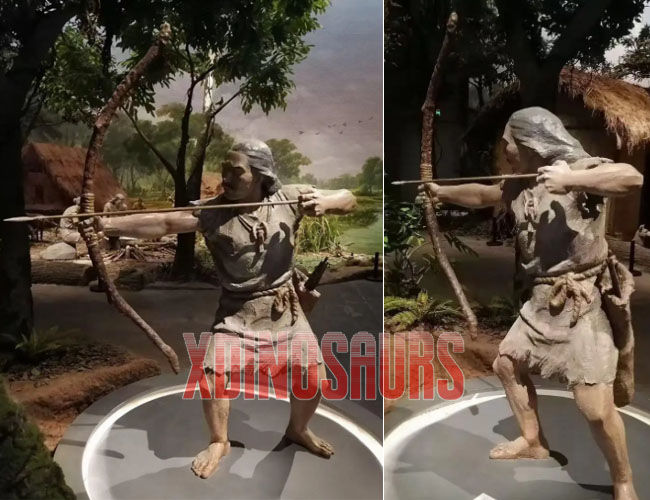
The lifelike Homo erectus model we created is much closer to the face of modern humans. It’s also worth noting that these primitive humans had already begun using clothing extensively for covering their bodies and keeping warm. Therefore, while creating the model, we also had to recreate various animal hides and coarse hemp clothing for them. The lifelike Homo erectus model is 5-10 centimeters taller than Homo habilis, clearly indicating that it had achieved a significant advancement in nutrition beyond just being able to grow.
More knowledge:
Homo erectus is an extinct ancient human species that lived approximately 2 million to 200,000 years ago. Its name derives from its distinctive feature of bipedal locomotion. Fossils have been found across Africa, Asia, and Europe, confirming its long-distance migratory capabilities and status as one of the first human populations to leave Africa. With an average cranial capacity of 900 to 1,200 cubic centimeters, Homo erectus possessed robust skeletons and tall stature, indicating adaptability to complex environments. Its cultural and technological advancements were significant: the Acheulean handaxe-making technique extended to East Asia, as evidenced by handaxes unearthed in the Baise Basin of Guangxi, dating back about 800,000 years, matching the cognitive level of contemporary Western humans. Homo erectus mastered fire use, which not only provided warmth and protection from predators but also transformed food preparation methods, promoting brain development. However, its fire preservation methods were relatively primitive, as shown by the ash layers at the Zhoukoudian site, requiring substantial fuel consumption to maintain the fire.
4. Neanderthal Man Model
There is no doubt that Neanderthals are one of the most well-known cave-dwelling humans. They were physically strong and generally retained the physical characteristics of robust ancient apes. Especially when making them, the wide forehead and large face shape, as well as the strong arm features, should be shaped out. The height of Neanderthals was generally between 165 and 171 centimeters, which was already relatively close to the body type of modern Homo sapiens.
More knowledge:
Neanderthals were close relatives of the ancestors of modern Europeans. From 120,000 years ago, they dominated the entire Europe, western Asia and northern Africa. However, these ancient humans vanished 24,000 years ago. The first Neanderthal skull fossil was discovered in Belgium in 1829, but it was not until 1856 when a skull and other bones were found in a cave in the Neander Valley in Germany and named Neanderthals that they became widely known. Fossil evidence shows that they were slightly shorter than early modern humans but had a stockier body and limbs, with a slightly larger average brain volume. They were widespread in Europe during the Late Pleistocene and also distributed in West and Central Asia. They appeared at least 230,000 years ago and became extinct around 30,000 years ago due to the flourishing of the ice age.
5. Denisovans Model
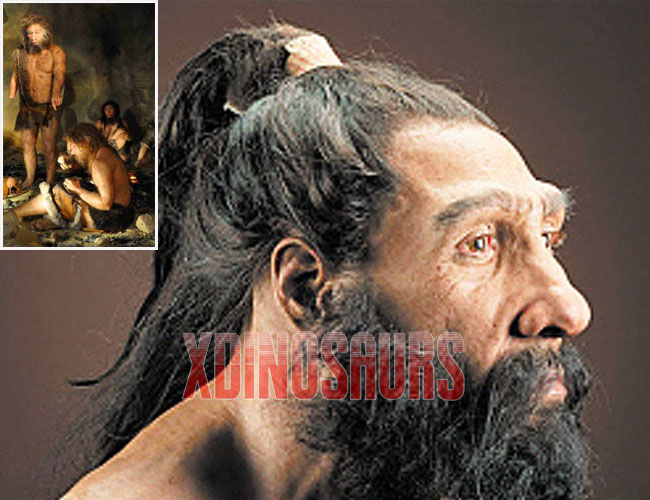
The Denisovans were also one of the very ancient cave-dwelling humans, disappearing just like the Neanderthals in the vast history of human evolution. When we were creating the model of the Denisovans, it was actually quite difficult to distinguish the differences between them and the Neanderthals. Perhaps there were some differences in their clothing. The physical features of the Denisovans were almost similar to those of the Neanderthals.
More knowledge:
The Denisovans were an extinct ancient human species closely related to the Neanderthals (a sister group). This species was identified through ancient DNA technology. The first fossil (a bone) of this species was discovered in the Denisova cave in Siberia in 2008. Studies have shown that the Denisovans were widely distributed in East Asia and contributed genes to some modern populations (such as those in Oceania and East Asia). Since 2019, Chinese scientists have successively discovered lower jaw fossils and rib fossils from at least 160,000 years ago in the Bai Shitiao cave on the Qinghai-Xizang Plateau, confirming that the Denisovans had long adapted to the cold and oxygen-deficient environment and lived there. In 2025, research on the ancient human skull in Harbin confirmed that it belonged to the Denisovans, solving the mystery of their morphological characteristics; in the same year, studies also proposed a new evolutionary branch of “Lungmen” closely related to the Denisovans, and successfully obtained the first case of Denisovan sediment DNA in the Qinghai-Xizang Plateau from this region.
6. Homo Sapiens Model
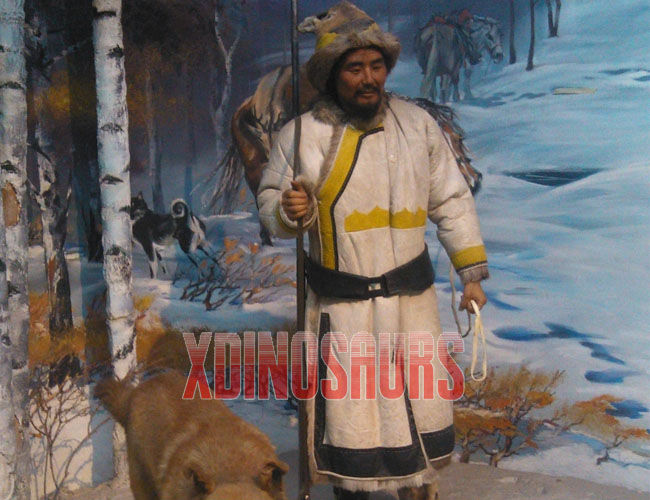
The appearance of Homo sapiens is actually almost 90% similar to that of modern humans. The only noticeable differences are probably the messy hair and simple clothing. If we create Homo sapiens models from tens of thousands of years ago, equipped with simple clothes, sticks, or bronze-like weapons or tools, they perfectly present the appearance of ancient Homo sapiens. Animatronic Homo sapiens models are usually displayed in various natural history museums, science and technology museums, etc., and can effectively convey the story of human evolution.
More knowledge:
Early Homo sapiens lived about 250,000 years ago and were prehistoric humans of the Middle Paleolithic period. They were mainly distributed in Asia, Europe, and Africa. The earliest discovered early Homo sapiens fossils were Neanderthals found in Germany in 1856. Some more well-known examples include the Bodo people found in Africa, the Petralona people found in Greece, the Ngandong people found in Indonesia, the Neanderthals found in Europe, and the Dali, Maba, and Xujiahe people found in China. Late Homo sapiens are called modern humans and lived from about 50,000 to 10,000 years ago, mainly distributed in Europe, Africa, Asia, Oceania, and the Americas. They were physically close to modern humans, made significant advancements in stone tool technology, widely used microliths made from narrow, long stone flakes, could sew clothes, build shelters, and had a set of burial customs for the dead. The evolution of ancient humans in China was continuous from Homo erectus through early Homo sapiens to late Homo sapiens. Yuanmou Man, from 1.7 million years ago, is the earliest Homo erectus discovered in China, and other Homo sapiens found include the Dali, Maba, Upper Cave, and Liujiang people.
Conclusion
The above six major categories of animatronic primitive human models are the ones we customize and sell the most. These six categories almost cover the distribution of human races in ancient times worldwide, and we have vividly turned them into models that can be displayed in various public settings. When visitors see the ancestors of humans presented before them, they can’t help but want to interact and take photos. If you also want animatronic primitive man models, you can contact us for customization.
Related Posts

6 Production Steps for Baby Monster Puppet / Prop (Zandrias Style)
In addition to the popular dinosaur puppets, we can also manufacture the increasingly popular animatronic…

Guides: Build Attractive Mall Outer Areas / Square (Dino & Pop Theme)
The outer areas of shopping malls or vacant commercial street squares are also places where…
4 Steps to Bring Your Armed Animal Puppet
In addition to our popular dinosaur hand puppets, armed animal themed puppets have gradually become…
Leave a Reply